

What a tiny SoHo shop reminded me about PYP learning environments, student agency, and the power of spaces that make us want to discover more.
Note: This post contains affiliate links. If you purchase through one of these links, I may earn a small commission at no additional cost to you.
I had just grabbed a slice of spinach pizza at Lucia Pizza on Canal Street — 375 Canal Street, and highly, highly recommend — and was walking through SoHo when I passed a literal tiny hole-in-the-wall shop.
At first, I just caught a glimpse of it and kept walking. Then I looked back for another quick glance while continuing down the street, but something about it had already pulled me in.
What was this place? What were all of those things? How had someone managed to make so many completely eclectic objects feel so perfectly curated and positioned? What had the person who designed the space been thinking?
It was one of those moments when questions flood your brain in the span of a few seconds. Even though I was still walking forward, something in me felt like I needed to go back and figure it out.
So I did.
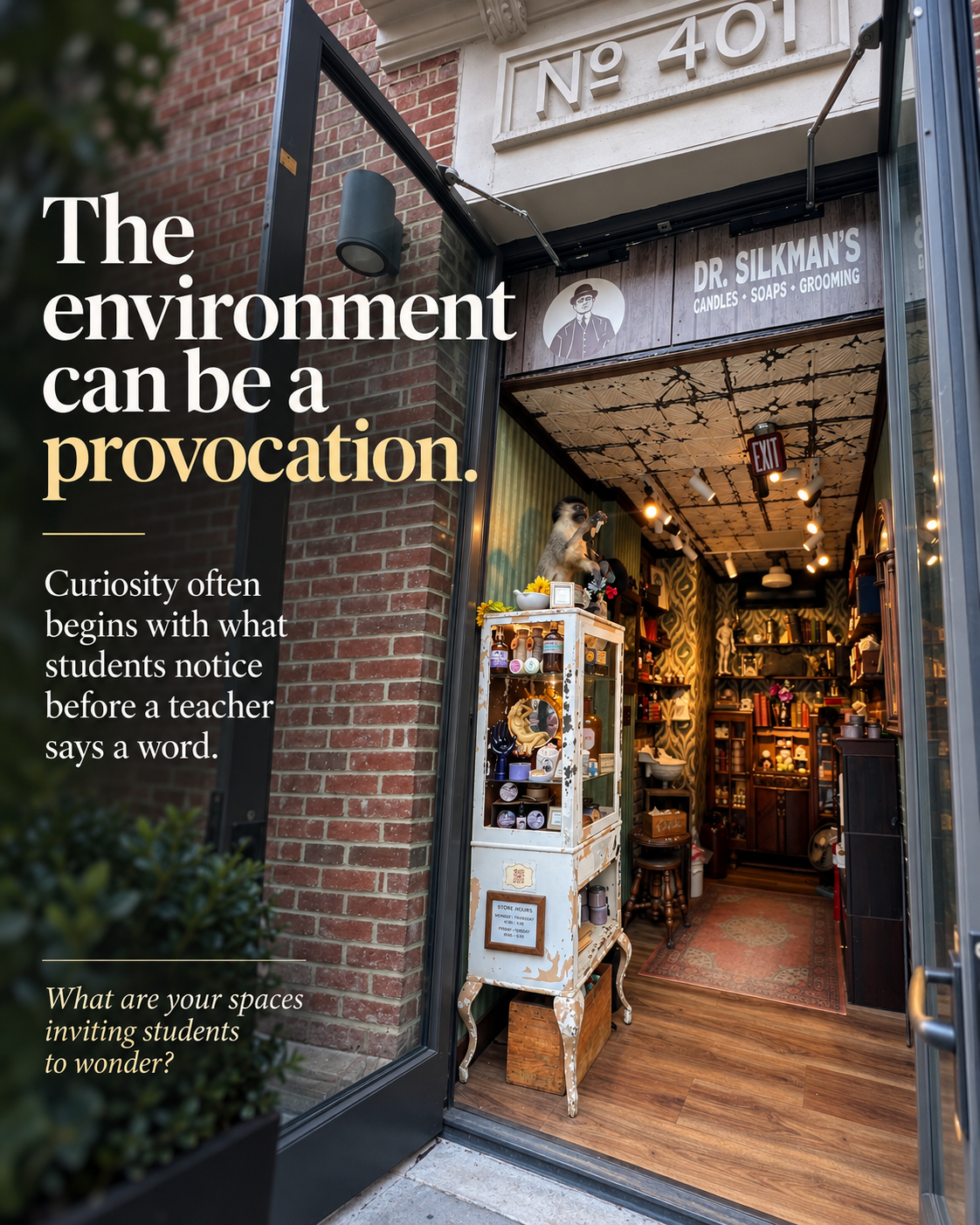
Sometimes curiosity begins before anyone asks a question.
Pictured here: Dr. Silkman’s: a tiny eclectic SoHo shop in New York City illustrating how an environment can inspire curiosity and inquiry.
The space was SO small that once the woman working there and the two of us were inside, it was basically full. But instead of feeling cramped, we found ourselves light hearted and chatty.
We looked at everything, pointed things out to one another, noticed strange little objects tucked into corners and found ourselves lingering far longer than we expected.
And afterward, I kept thinking about why.
It wasn’t because the space was large, polished or perfectly coordinated. It was because of how it made us feel. There was an energy to it. It made us curious before anyone explained anything. It invited us to look more closely, make connections, ask questions and discover.
As an educator, that stayed with me.
Sometimes the environment itself is the provocation
In inquiry-based learning, and particularly within the IB Primary Years Programme, we often talk about provocations as something we intentionally place in front of students: an object, an image, an unusual collection of materials, a question or an experience designed to spark thinking.
But sometimes the environment itself is the provocation.
A thoughtfully designed classroom can communicate so much before a teacher has said a word. It can make a child want to move closer, notice something unexpected, wonder why two things have been placed together, begin a conversation or simply feel that this is a place where curiosity is welcome.
That doesn’t mean every classroom needs to look like an interior-design photograph.
What interests me much more is the relationship between environment and thinking.
What does the space invite the learner to do?
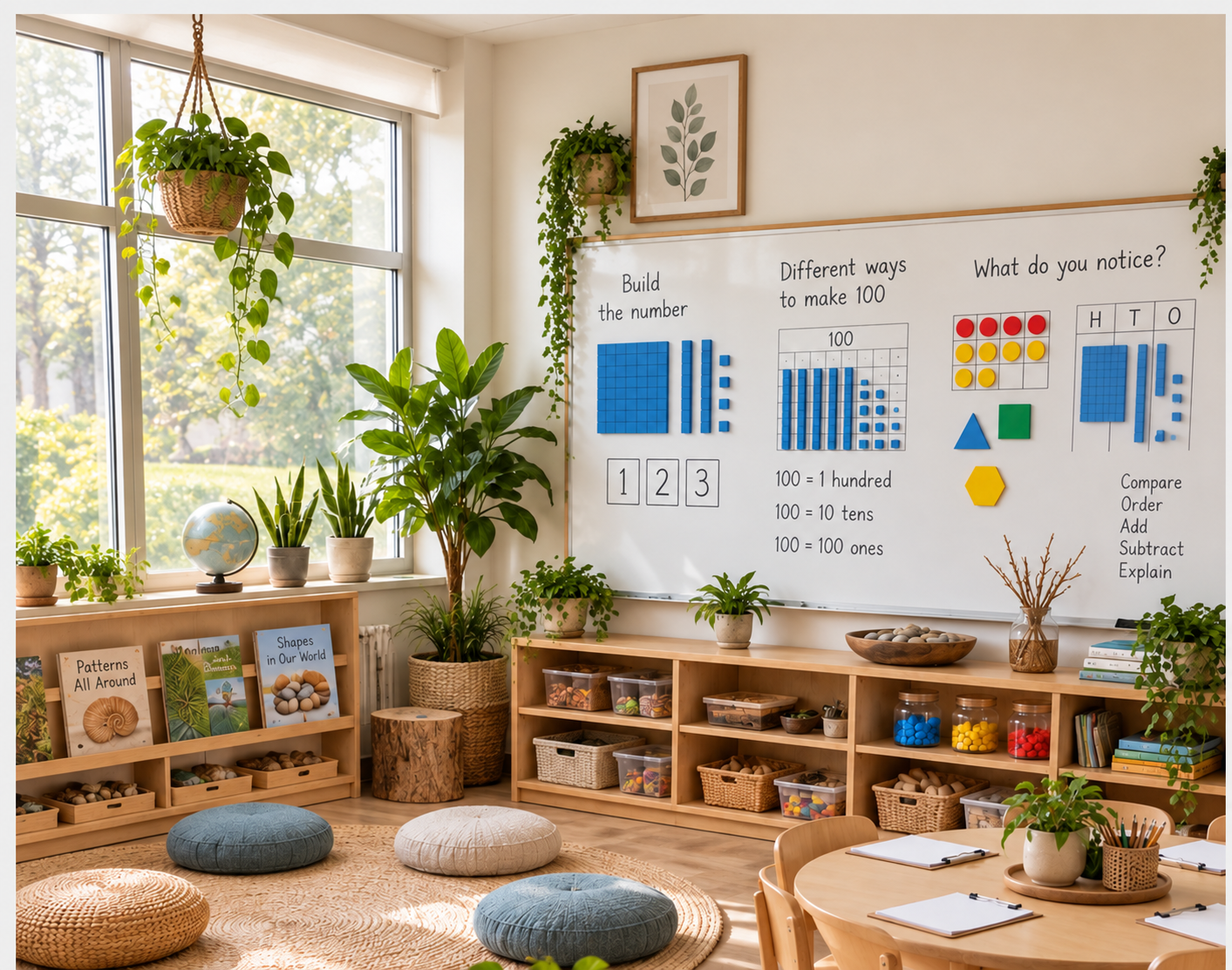
Magnetic math manipulatives on a classroom whiteboard supporting hands-on mathematical thinking and representation. A whiteboard becomes much more powerful when students can move, build, compare and represent ideas directly on it.
Designing for thinking, not simply decoration
There is a difference between a classroom that is beautifully decorated and a classroom that is intentionally designed for learning.
Decoration asks:
Does this look good?
Learning-environment design asks:
What might this make a learner notice, feel, wonder or do?
That distinction matters in concept-based and inquiry-based learning because so much of the thinking we want cannot simply be delivered to students. We want learners to make connections, develop ideas, test possibilities and revise their thinking.
The physical environment can quietly support those habits.
A table can become a place for dialogue and shared problem-solving. A shelf can make possibilities visible. A whiteboard can become a place where students manipulate ideas rather than simply receive information.
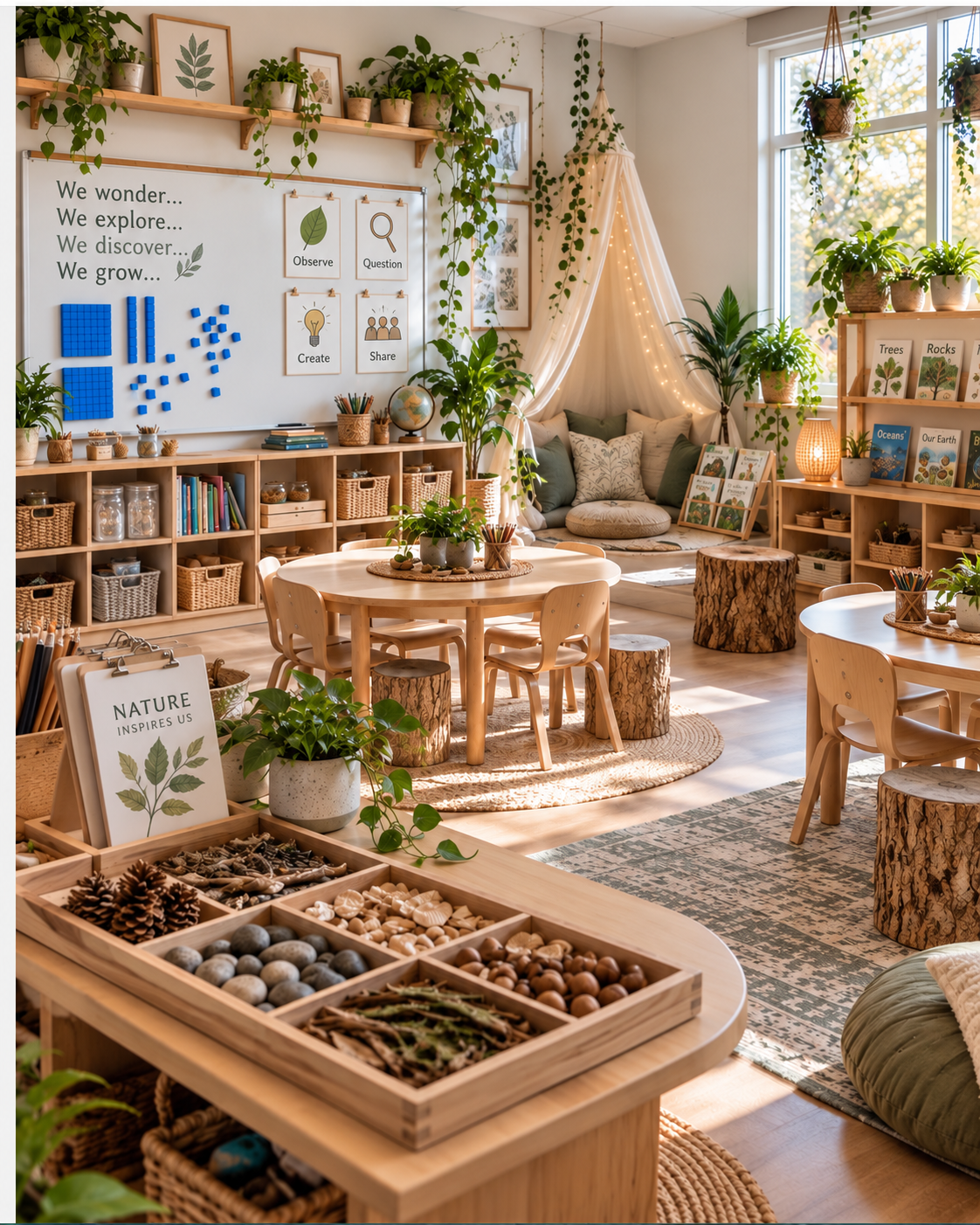
An inviting classroom can offer different entry points into learning: collaboration, conversation, observation, reading and quiet thinking.
This is where resources such as magnetic base-ten blocks, magnetic fraction pieces, magnetic number lines and other hands-on math manipulatives can become genuinely useful.
Rather than mathematics living only on paper, students can physically build a number, reorganize a pattern, compare quantities or show multiple representations of the same idea.
That is when a classroom resource earns its place for me: not because it makes the room look complete, but because it makes thinking more visible.
Small materials can create big questions
Some of my favorite classroom provocations begin with very ordinary materials.
Stones. Seed pods. Shells. Leaves. Acorns. Pine cones. Pieces of bark. A chalkboard. A magnifying glass. Natural wood slices. A wooden drawer organizer.
Placed thoughtfully, they can create an invitation without requiring an elaborate lesson around them.
This is one reason I love keeping magnifying glasses accessible to students. There is something wonderfully literal about handing a child a tool whose entire purpose is to say, look more closely.
Simple wooden trays can transform a collection of ordinary objects into something that feels worth investigating. Natural baskets make materials visible and accessible without creating visual clutter. Small acrylic display stands or picture holders can pair a photograph, question or piece of text with an object and instantly create a connection students can begin interpreting.
None of these things creates inquiry by itself.
What matters is the thinking they help make possible.
Spaces can offer different kinds of thinking
Another thing I notice in classrooms I find most inviting is that they do not ask every child to learn in exactly the same physical position all day.
There may be tables for collaboration, but there are also places to read, talk quietly, sit on the floor, investigate independently or simply retreat for a few minutes.
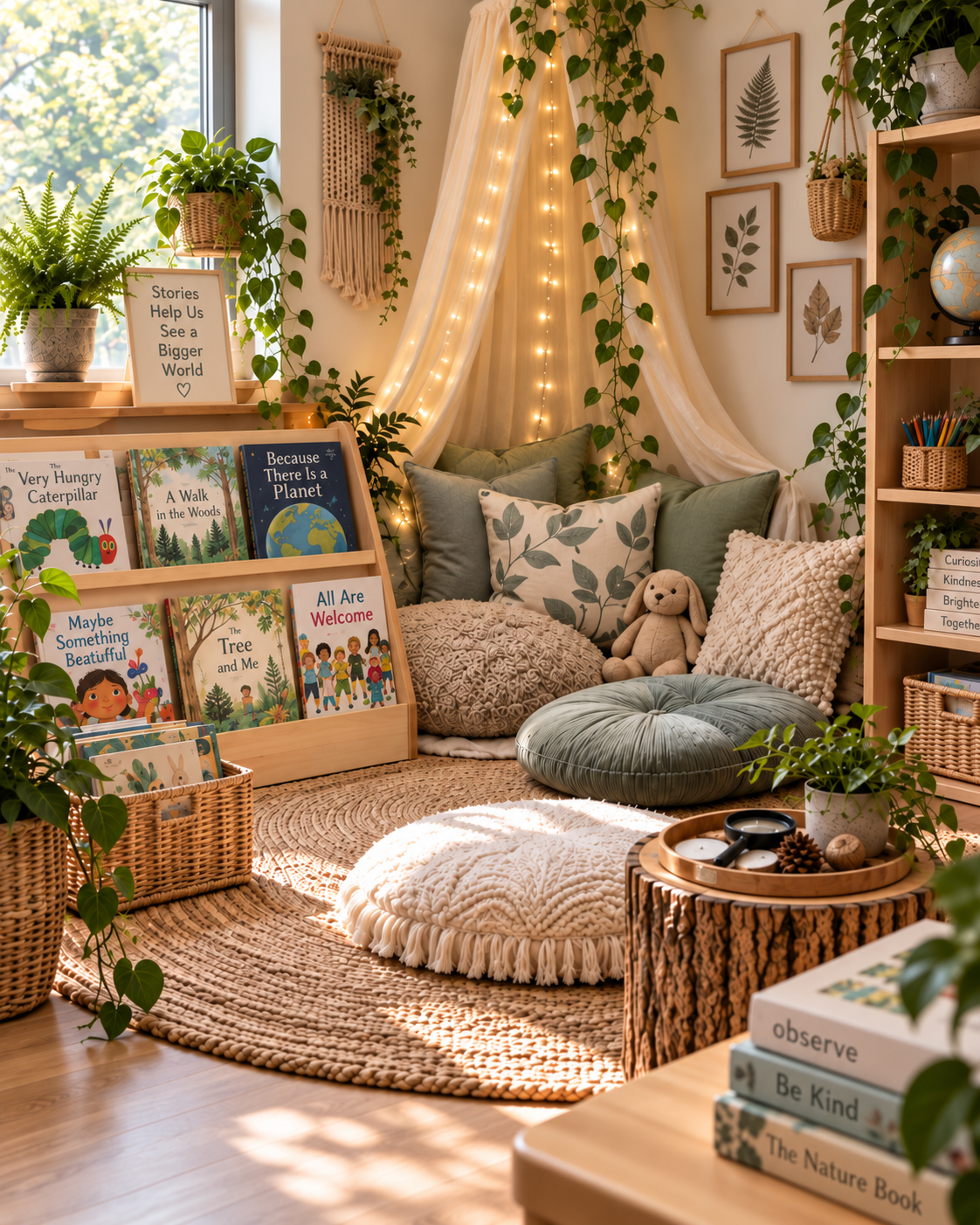
Different spaces can invite different kinds of thinking: collaboration, reflection, conversation, observation and quiet concentration.
The natural materials, plants, open-ended objects and intentional presentation in these images are reminiscent of Reggio Emilia-inspired learning environments, where the environment itself is often understood as playing an active role in learning.
Reggio Emilia and the PYP are not the same educational approach, but there is an interesting point of connection: both ask us to take learners seriously as thinkers and to consider how the environment can support curiosity, agency and meaning-making.
The height of a shelf communicates who is allowed to access it. The way materials are displayed communicates whether they are meant to be touched. The arrangement of tables communicates whether learning is primarily individual or collaborative.
Even the amount of empty space can communicate whether there is room for students to add something of their own.
An intentional classroom does not have to be expensive
Creating an inquiry-rich classroom does not mean replacing every piece of furniture or buying an entirely new collection of materials.
Sometimes the strongest changes are small.
Move books so children can see the covers rather than only the spines.
Put an interesting natural object beside a magnifying glass.
Bring useful materials out of a cupboard and place them where students can independently access them.
Use a magnetic whiteboard as a place where learners can construct ideas.
Add a basket of loose parts.
Create one comfortable corner where a child can settle with a book.
The goal is not to create a classroom that photographs beautifully.
The goal is to create a classroom that feels alive with possibility.
That tiny shop in SoHo reminded me that spaces have a language of their own.
Before we have even asked the first question, the environment has already said something.
And so perhaps one of the most useful questions we can ask when we look around our classrooms is this:
What is this space already inviting my students to notice, wonder about and explore?
Simple Materials for Creating More Inquiry in Your Classroom
I would keep this section concise and practical.
Student magnifying glasses
Useful for science investigations, natural collections, artifacts and provocations that encourage closer observation.
Magnetic math manipulatives
Base-ten blocks, fraction pieces, number lines and other magnetic resources can turn the classroom whiteboard into an interactive thinking space.
Wooden trays or shallow display trays
Useful for loose parts, natural materials, artifacts, sorting collections and small provocations.
Natural storage baskets
Helpful for keeping books and materials visible, organized and accessible to students.
Acrylic photo or sign holders
An easy way to pair images, student questions or short pieces of text with physical materials.
https://amzn.to/4qYx3pm